
Master Accounts Payable vs Accounts Receivable to Strengthen Cash Flow
When you're managing the finances of a business, especially in a fast-paced market like Denver, Colorado, it's essential to grasp the difference between accounts payable and accounts receivable. These two processes - known as AP and AR in the accounting world - sit at the heart of your company's cash flow, and when handled well, they keep your business running smoothly.
But what's the difference between accounts payable vs accounts receivable, and why should you care?
Let’s break it down in this article.
The Basics: What Are Accounts Payable and Accounts Receivable?
To get a handle on your financials, you need to understand how accounts payable and accounts receivable work.
What Is Accounts Payable (AP)?
Your accounts payable account, or AP, represents the money a business owes to its suppliers or vendors. It’s a liability account - which means it reflects debt or money your business needs to pay.
Think of it this way: when your company gets billed with an invoice after receiving a good or service, that bill becomes part of your accounts payable balance. It's money owed that needs to be paid within an agreed-upon due date.
Examples of accounts payable include:
Utility bills
Office equipment purchases
Inventory purchase orders
Consultant or contractor fees
Once payment is made, the balance reduces.
Accounts payable is listed as a current liability on your balance sheet, meaning it’s due in the short term (usually within a year).
What Is Accounts Receivable (AR)?
Your accounts receivable, or AR, is the flip side. It’s the money owed to your business by customers who have received goods and services but haven’t yet paid.
When you send out an invoice to a client, it becomes part of your receivable accounts. This is listed as a current asset on your balance sheet, since it’s money likely to come in soon.
Accounts receivable is money owed that strengthens your working capital and cash position when finally collected.
Understanding Accounts Payable vs Accounts Receivable
So, what's the difference between accounts payable vs accounts receivable?
Let’s explore the key differences in this table:
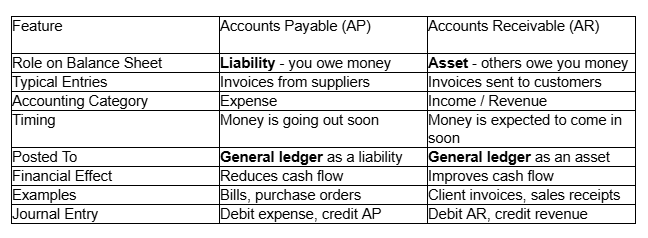
Understanding this table can help streamline your finance team’s efforts and efficiently manage your general ledger.
Why the Difference Between Accounts Is Crucial
When you're swamped with daily operations, it can be easy to lose sight of how these two areas impact your business. But overlooking the differences between accounts payable vs accounts receivable can lead to poor financial health, strained supplier relationships, or missed revenue.
Here’s why the difference matters:
Strategic cash flow management: Knowing your AR and AP makes it easier to anticipate inflows and outflows.
Stronger vendor relationships: Timely payments to suppliers improve trust and may allow you to receive discounts for early payment.
Better planning: Understanding AR means you can predict income and budget with more confidence.
Exploring Accounts Payable in Detail
How Does the Accounts Payable Process Work?
The accounts payable process is the workflow from receiving an invoice to making the payment. Here's a typical flow:
Receive goods or services.
Supplier sends an invoice.
The accounts payable department verifies the invoice vs the purchase order and delivery.
The invoice is approved.
Journal entry is recorded.
Payment is made before the due date.
This amount is recorded as a journal entry and posted to the general ledger.
Tips to Improve the AP Process
To reduce errors and late fees, consider these:
Use cloud accounting software to automate data entry.
Monitor days payable outstanding to manage outflows effectively.
Establish strong internal controls to reduce the risk of fraud.
Leverage dynamic discounting options to get early payment discounts.
By improving your AP process, you’ll strengthen relationships with suppliers while managing cash outflow more strategically.
Digging Into Accounts Receivable
How Does the Accounts Receivable Process Work?
The accounts receivable process starts when a sale is made to a customer on credit.
Deliver goods or services.
Send out an invoice.
Record it in the general ledger under receivable accounts.
Monitor payment terms closely.
If payment is delayed, take action via debt collection or contact support.
Since receivables are the money owed to your business, staying on top of it is key to keeping your cash flow healthy.
Accounts Receivable Best Practices
Enforce strict payment terms.
Track accounts receivable turnover ratio to identify problems early.
Offer flexible credit terms without risking overdue receivable accounts.
Identify and manage doubtful accounts to keep your books clean.
Use modern accounting software to automate follow-ups.
Need help managing your receivables? Learn more about our accounts receivable services in Denver.
Using Accrual Accounting: Matching AP and AR
Under accrual accounting, businesses record accounts payable and accounts receivable when transactions occur, not when money actually changes hands.
This fundamental accounting principle improves the accuracy of your financial statements and aligns income with expenses, providing better insight into financial health.
So, when your team records a transaction:
A sale generates a receivable (an asset).
A purchase generates a payable (a liability).
And both are logged in the double-entry bookkeeping system using debits and credits.
The Relationship Between Accounts Payable and Receivable
The relationship between accounts payable and accounts receivable is like two sides of the same financial coin.
When managed together:
You maintain healthy working capital.
Improve cash flow visibility.
Prevent late payment scenarios.
Optimize use of credit and capital.
Proper AR and AP alignment helps decision-makers:
Avoid overspending.
Ensure there’s always cash on hand.
Plan funding when additional support is needed.
From an operational standpoint, the goal is to pay on time and get paid faster.
Automate and Streamline: AP and AR Technology Tools
Modern businesses in Denver are turning to cloud-based accounting software and automation technologies to take control of their AP and AR workflows.
These systems can help:
Automate data entry, invoice matching, and approvals.
Integrate with optical character recognition for faster invoice processing.
Improve internal control through better logs and audit trails.
Protect against fraud with smarter checks and workflows.
Allow for better data analysis and reporting.
Whether it's syncing with your bank statement, tracking payments, or auditing transactions, tech-driven systems reduce errors and speed up the process.
Final Thoughts: Understanding Accounts Payable vs Accounts Receivable Matters
In the world of accounting, it's vital to understand what's the difference between accounts payable and accounts receivable.
By managing both areas well, your business will:
Improve cash flow
Stay compliant with generally accepted accounting principles
Strengthen supplier and customer relationships
Reduce exposure to debt, fees, and late payment problems
If you're in Denver and juggling too many unpaid invoices or are unsure how to handle your growing vendor list, it might be time to streamline with expert help.
Take Action: Whether you're building your accounts payable department, improving accounts receivable processes, or just want to get a tighter grip on your balance sheet, don’t let the complexity slow you down. Start small: audit your current AP and AR systems, identify where invoices get stuck, and look for opportunities to automate.
Looking for hands-on help? Reach out for local, trusted guidance to handle your day-to-day accounting with confidence.
