
Here’s How Expert Accounting and Bookkeeping Services Help Grow Your Business

Running a business in Denver can be rewarding, but tracking every dollar, invoice, and tax return? That’s a different story. If you've ever wondered what the difference is between a bookkeeper and an accountant, or whether you need either (or both), you're not alone.
Understanding the differences and how the right support can impact your financial health isn’t just helpful - it’s essential.
Let’s take a straight-talking look at bookkeeping and accounting, how they support your organization’s success, and what to consider when hiring a professional in Denver.
What Is Bookkeeping? Why Does It Matter?
Bookkeeping is the process of recording daily transactions like sales, expenses, and purchases. It’s the first and most fundamental part of the accounting process.
A bookkeeper’s role is to record financial transactions accurately and consistently, serving as the foundation for all higher-level financial analysis and decision-making. Bookkeeping focuses on:
Logging receipts and invoices
Tracking accounts payable and accounts receivable
Maintaining a general ledger
Reconciling bank statements
Preparing basic financial statements
Bookkeeping may seem like minutia, but it is crucial for maintaining accurate financial records and managing cash effectively.
If you’re a business owner in Denver and struggle to keep your general ledger up-to-date, partnering with a professional bookkeeper in Denver can make all the difference.
What Is Accounting?
Accounting builds upon bookkeeping. While bookkeeping involves recording information, accounting interprets and analyzes that information to help with strategic business decisions. This includes:
Preparing in-depth financial statements
Performing internal audits
Tax planning and filing tax returns
Analyzing financial data for trends
Advising on cash flow, financing, and investments
An accountant needs a deeper understanding of financial principles and often holds a degree in accounting or finance. Many accountants are certified as a Certified Public Accountant (CPA), which requires a bachelor’s degree, passing the CPA exam, and meeting licensure requirements in your state.
Bookkeeping vs Accounting: What's the Difference?
So, what’s the difference between bookkeeping and accounting?
The key differences between bookkeeping vs accounting include:
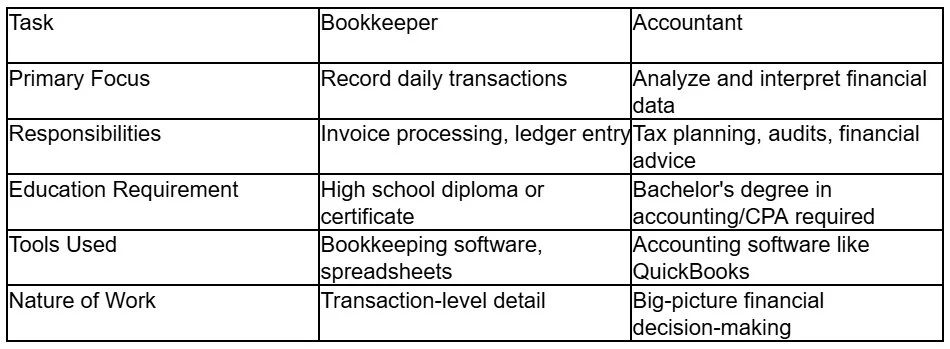
While both roles are part of the accounting process, understanding the differences between the two helps you hire the right expertise at the right time.
Do I Need a Bookkeeper or an Accountant?
This is one of the most frequently asked questions among small business owners in Denver.
The answer depends on your needs.
If you’re focused on keeping accurate records, managing payroll, and ensuring receipts are properly filed, a bookkeeping professional may be all you need.
If you need help with taxes, financial statements, or business strategy, you’ll benefit from hiring an accountant.
Many businesses work with both to cover the full spectrum of financial needs. Bookkeepers and accountants work hand-in-hand: bookkeepers maintain the records; accountants analyze the financial data.
Job Titles in Accounting and Bookkeeping
Titles in this field can be a bit overwhelming. Here's a quick breakdown to make things clearer:
Bookkeeper: Handles accounts receivable, accounts payable, invoices, and ledgers.
Accounting Clerk: Similar to a bookkeeper, often in a support role.
Accountant: Prepares financial statements, tax returns, advises on strategy.
Auditing Clerk: Reviews accuracy of financial records.
Internal Auditor: Evaluates internal processes and identifies risks.
CPA (Certified Public Accountant): Licensed professional able to file reports with the IRS and perform audits.
Enrolled Agent: Licensed by the IRS to represent taxpayers.
Education and Training Requirements
The paths to becoming a bookkeeper vs accountant are different.
How to Become a Bookkeeper
Education: High school diploma is typically the minimum.
Training: Many gain skills through bookkeeping classes or on-the-job training.
Certification: Not required, but options like the Certified Bookkeeper credential can boost your credibility.
Becoming an Accountant
Education: Typically a bachelor’s degree in accounting or a closely related field.
Certification: Becoming a CPA often involves a degree in accounting, passing an exam, and professional experience.
Skills Needed for Success
Regardless of title, clear skills are vital in accounting and bookkeeping:
Attention to detail and being good with numbers
Comfort with spreadsheets and accounting software like QuickBooks
Understanding general ledger concepts
Ability to interpret financial information
Knowledge of tax law and compliance
Familiarity with financial statements like profit and loss reports and balance sheets
The Tools of the Trade: Software and Automation
Many professionals now use accounting software and bookkeeping software that automates repetitive tasks, saving time and improving accuracy.
Some popular tools for Denver-based businesses include:
QuickBooks: Widely used for its user-friendly interface and powerful features.
Xero
FreshBooks
Wave
Automation is reducing manual entry but increasing the need for professionals who can correctly interpret outputs and customize systems.
Bookkeeping and Accounting Career Paths and Job Outlook
According to the Bureau of Labor Statistics, roles in bookkeeping and accounting are expected to grow steadily over the next decade.
Job growth: Over 170,000 job openings for accounting and auditing professionals are projected each year.
Job titles like bookkeeper, auditing clerk, and accountant remain in high demand.
Salary expectations vary based on education, certification, and experience.

Note that while bookkeepers often learn through on-the-job training, accountants typically require postsecondary education or a bachelor’s degree.
When You Might Need an Audit
Whether it's an internal audit to ensure compliance or a scheduled audit for your tax return, having accurate books and financial records directly impacts your audit risk.
A certified public accountant or internal auditor can help:
Verify the accuracy of financial data
Detect errors or fraud
Ensure compliance with tax regulations and bank requirements
Staying prepared means no surprises during tax season or when applying for a loan.
Business Owners: Why Professional Help Matters
Trying to DIY your books or taxes might seem cost-effective. But errors in your financial transactions, tax strategies, or financial statements can be costly. Professional bookkeeping and accounting support:
Saves time and reduces errors
Helps with managing your business finances
Offers informed insights for better business decisions
Even if you use software, expert oversight ensures everything stays accurate and compliant.
Frequently Asked Questions
-
A bookkeeper handles the recording of daily transactions and maintains the general ledger. An accountant takes that data to prepare financial reports and advise on decisions. The key difference lies in skills, education, and responsibilities.
-
You don’t need a CPA for everyday bookkeeping. But if you're seeking professional tax advice, considering an audit, or submitting paperwork to the IRS, hiring a certified public accountant is a smart move.
-
Software like QuickBooks and spreadsheets help, but can’t fully replace the understanding, strategy, and compliance abilities of a qualified bookkeeper or accountant.
-
Understanding the basics is helpful for every business owner. Still, if bookkeeping is not your area of expertise, hiring a local professional will save time and prevent costly mistakes.
Final Thoughts: Get the Support You Need
From recording financial transactions to preparing a tax return, accounting and bookkeeping are vital to your business’s success. Whether you just need a reliable bookkeeper to track your invoices and payments, or an accountant to help interpret financial data and plan for taxes, expert guidance ensures your numbers add up.
Not sure where to start? Connect with a professional bookkeeper in Denver, and see how the right support can make managing your books a whole lot simpler.
