
Decode the Difference Between 990 and 990 EZ: Choose the Right IRS Form Fast
If you run a nonprofit organization, understanding your filing requirements with the IRS can feel overwhelming. You might be asking yourself: What’s the difference between Form 990 and Form 990-EZ? Or how do I know if I need to file Form 990-N instead?
Let’s break down the key differences between these nonprofit tax forms so you can quickly determine which IRS form is the right one for your organization.
Overview of Form 990 and Form 990-EZ
Form 990, Form 990-EZ, and Form 990-N are all part of the Form 990 series, used by tax-exempt organizations to report their income, expenses, and assets to the Internal Revenue Service (IRS). These documents help the IRS ensure that your organization is maintaining its tax-exempt status, and they also promote transparency for donors and the public.
But knowing which form to file depends mostly on your organization’s gross receipts and total assets.
Here’s an overview of the three main types:
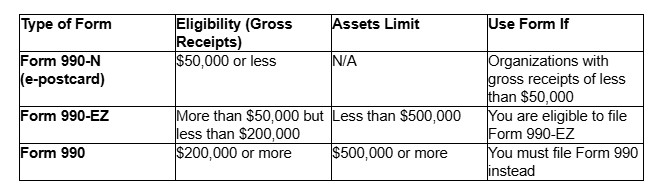
Form 990 vs Form 990-EZ: Key Differences Between Form 990 Options
Now, let’s zoom in on the difference between Form 990 and Form 990-EZ.
1. Length and Detail Required
Form 990: This is the full Form 990 and the longest form of the three. It’s comprehensive and requires detailed financial statements, including a balance sheet, revenue breakdown, expenses, and much more about your operations.
Form 990-EZ: A simpler, shorter version. It still asks for details like mission, program accomplishments, and trustee information, but with less granularity.
2. Eligibility Based on Financial Thresholds
Organizations with gross receipts between $50,000 and $200,000 and total assets under $500,000 are eligible to file Form 990-EZ.
If your annual gross receipts are normally $200,000 or more or your assets exceed $500,000, you are required to file Form 990 instead of 990-EZ.
3. Organization Complexity
Complex organizations like a 501(c)(3) organization, trust, or charitable trust with diverse programs or foreign activities typically must file the longer Form 990.
Vs Form 990-EZ: When to File Form 990-N
Form 990-N is also known as the e-postcard. This is the simplest electronic form and requires minimal information. It's submitted online through the IRS’s electronic form system.
Eligible to File Form 990-N?
You can submit Form 990-N if:
Your organization is a small tax-exempt organization with gross receipts of $50,000 or less, and
You did not choose to file Form 990 or Form 990-EZ.
But here's the catch: If your organization fails to file Form 990-N for three consecutive years, it will automatically lose tax-exempt status.
Filing Form 990: Timing and Requirements
Forms Are Due When?
No matter which form you choose, forms are due by the 15th day of the fifth month after the close of your fiscal year. So if your tax year ends on December 31, your filing deadline is May 15.
Organizations Must File One of These Forms If:
They're a 501(c) organization, including charitable trusts, foundations (Form 990-PF), or others covered under the Internal Revenue Code.
They are required to file based on their organization’s gross receipts and total assets.
How to Determine Which Form You Must File
To determine which form to file, ask yourself:
What are your average gross receipts over the past three consecutive years?
What are your organization’s total assets?
Do you operate under a fiscal year or calendar year tax cycle?
Does your organization fit the description of a midsized tax-exempt organization?
Annual Gross Receipts Are Normally Below $50,000?
Then you’re likely eligible to file Form 990-N.
Between $50,000 and $200,000?
That places your organization in the 990-EZ vs 990-N decision zone. If you don’t qualify for Form 990-N anymore due to growth, your next option is to file your form 990-EZ.
Above $200,000 or Assets Over $500,000?
You must file the full Form 990 instead. This is where working with a knowledgeable Certified Public Accountant who understands nonprofit tax filing becomes key.
Need help? Consider working with a trusted nonprofit accountant in Denver to reduce filing stress and ensure accuracy.
Filing These Forms: What You’ll Need
No matter which 990 or 990-EZ form you’re filing, gather this info:
Employer Identification Number (EIN) or Taxpayer Identification Number (TIN)
Your organization’s fiscal year and tax year information
Mission statement, major programs, and accomplishments
Revenue, expenses, and any transactions with officers or trustees
Your organization’s financial statement or balance sheet
For Form 990-EZ Filers, ensure that you're meeting the simplified filing requirements
Filing Mistakes to Avoid
Filing the wrong type of form
Missing your due date (remember: 15th day of the fifth month)
Basing eligibility on one year instead of three consecutive years
Assuming that your tax-exempt organization cannot file Form 990-N without checking gross receipts
If you fail to file for three years, your organization’s tax-exempt status will be revoked by the IRS.
Final Thoughts: Choose the Right Form With Confidence
Understanding the key differences between Form 990, Form 990-EZ, and Form 990-N is critical for staying compliant and transparent. Whether you need to file Form 990, file Form 990-EZ, or file Form 990-N, the choice depends mainly on your annual gross receipts and total assets.
Take the time to determine which required form applies to your nonprofit, and don't hesitate to ask for expert help.
For official guidelines, visit the IRS Form 990 overview.
Still feeling unsure? Connect with a local nonprofit accountant in Denver who has experience working with 501(c)(3) organizations, financial data, and trust law to guide your nonprofit tax decisions with accuracy.
Now it's your turn: Review your financials, determine which form you must file, and file your form 990 or 990-EZ with confidence.
