
Is Service Revenue an Asset? Clear Answers for Smarter Accounting

Understanding how to categorize service revenue can be confusing, especially if you're a business owner managing your own books or helping run a small company. You might be wondering where all that revenue from providing services fits into your financial statements. Is service revenue an asset? Or is it something else entirely?
Let’s break it down clearly so you can make smarter accounting decisions and stay on top of your bookkeeping with confidence.
What Is Service Revenue?
Service revenue is the income a company earns from providing a service to customers, as opposed to selling a physical product. It’s one of the most common revenue streams for businesses in industries like consulting, design, education, and software as a service (SaaS).
Common examples of service revenue include:
Fees charged by consultants, therapists, or tutors
Subscription service payments for software platforms
Charges for ongoing service, like maintenance or support contracts
Project revenue from one-time engagements like web design
Service revenue includes both recurring revenue (like monthly subscriptions) and one-time payments.
Is Service Revenue an Asset?
The short answer is no; service revenue is not an asset. It’s considered income and is recorded on the income statement, not the balance sheet.
Here’s why:
An asset is a resource a company owns or controls that has future economic value (like cash, inventory, or accounts receivable).
Service revenue doesn’t represent something you own. Instead, it reflects income earned in exchange for providing a service.
That’s often confusing because revenue increases your company’s cash or receivables, which are assets. But the revenue itself? It’s not an asset account.
However, when you receive payment in advance for services not yet delivered, that income is considered a liability until earned. In this case, it’s called deferred revenue or unearned revenue and reported as a liability on the balance sheet.
Types of Service: What Counts as Service Revenue?
When understanding the type of service revenue your business generates, consider the following types of service:
Ongoing service: Monthly retainers, managed IT services, or subscription-based support.
Transaction-based revenue: Charged per service completed, like a one-time consultation or repair job.
Project revenue: One-time custom work like construction, app development, or videography.
Subscription revenue: Recurring charges, such as a SaaS platform or membership portal.
Each type of service revenue has slightly different accounting methods, especially when it comes to timing, invoicing, and recognizing revenue on financial statements.
How to Record Service Revenue Properly
Using the proper system of accounting ensures your books reflect your operations accurately.
Here’s how to record service revenue if you're using the accrual accounting method (the preferred GAAP-compliant method):
When service is provided (not when cash is received):
Record revenue even if the customer hasn’t paid yet.
Use the accounts receivable account to show money owed by customers.
When payment is received before the service is delivered:
Record it as unearned revenue (a liability).
Move it to the service revenue account once the service is completed.
These entries follow the double-entry system, impacting both your revenue and assets or liabilities.
Service Revenue on an Income Statement
So where exactly does service revenue go?
Service revenue appears at the top of the income statement under the revenue section. It represents the income generated by a company through its service offerings during a specific accounting period.
Service Revenue Formula
To calculate your service revenue, use this simple formula:
Service Revenue = Number of Services Delivered × Price per Service
Or, if services vary:
Service Revenue = Sum of All Service Income Earned
This helps determine your company’s total revenue from services and is essential for tracking profit (accounting) and business growth.
Service Revenue vs. Other Revenue Types
There are different types of revenue a company can earn. It's important to distinguish service revenue from other types:

Service revenue may also be categorized under operating revenue, depending on how your accounting team buckets recurring income.
Why Service Revenue Isn’t an Asset: The Key Differences
Let’s clarify this with a direct contrast:
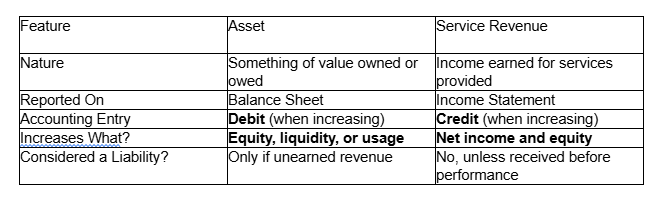
In simple terms, service revenue doesn’t include items that provide lingering benefits. It's recorded as income the moment it’s earned, not as a long-term benefit or investment.
Handling Deferred Service Revenue
A key hurdle in accounting is how to account for deferred revenue when using the accrual accounting method.
If you receive payment today for services to be rendered next month:
You cannot list it as service revenue right away.
Instead, it’s considered a liability, as you owe the service to the customer.
Once you deliver the service, you convert that liability into earned service revenue.
Sound complex? Don’t worry, your accounting team or Denver bookkeeping services like AY Miller can help automate and manage these entries accurately.
How Service Revenue Impacts Financial Statements
Let’s look at how service revenue affects each primary financial report:
Income Statement: Service revenue increases total revenue, which flows down to increase net income.
Balance Sheet: While service revenue itself isn’t listed, once it earns cash or accounts receivable, those assets appear here.
Statement of Cash Flows: If cash is collected upon delivering the service, it affects your cash flow from operations.
By knowing how your revenue streams impact each financial statement, you’ll make more informed decisions and have a clearer view of your company’s health.
Using Software to Help Track Service Revenue
Modern accounting software and customer relationship management platforms simplify how you calculate service income, maintain an up-to-date general ledger, and produce accurate financial statements.
Helpful features include:
Automatic recognition of earned revenue based on your method of accounting
Easy tracking of accruals, deferrals, and outstanding accounts receivable
Monthly reporting of how much revenue was earned vs. deferred
These tools are especially useful for businesses operating on a subscription business model or with complex billing structures.
Key Takeaways: Is Service Revenue an Asset?
Let’s summarize what you’ve learned:
Service revenue is a type of revenue, not an asset.
It’s recorded on the income statement, not the balance sheet.
When unearned, it’s reported as a liability until you perform the service.
Revenue is usually recorded using the accrual accounting method.
Service revenue increases net income, equity, and your company’s success metrics.
If you're unsure how to handle your service income or struggling to balance your books, you’re not alone. Good accounting is the foundation of a strong business.
Get expert support from professionals who understand your business model and the nuances of revenue accounting. Whether you're starting out or scaling up, teams like those at AY Miller's Denver bookkeeping services are here to help.
Want more clarity on service revenue or other accounting topics?
Bookmark our blog or follow us for regular updates and financial tips tailored to savvy business owners.
