
What Is Full-Service Bookkeeping? Discover What It Really Includes and Why It Matters

If you're a business owner trying to stay on top of your finances, chances are you've come across the term full-service bookkeeping. But what exactly does that mean? And more importantly, how can it help your business thrive?
Let’s break it down in simple terms.
Understanding Bookkeeping: The Backbone of a Company’s Financial Success
At its core, bookkeeping is the process of recording, organizing, and managing a business's financial transactions. From tracking income and expenses to maintaining accurate records for tax season, bookkeeping forms the foundation of your company's financial health.
Bookkeeping also plays a crucial role in preparing financial statements like the balance sheet, income statement, and cash flow statement, all of which are essential for making informed financial decisions.
What Exactly Is Full-Service Bookkeeping?
Full-service bookkeeping goes beyond just recording transactions. It’s a comprehensive, professional bookkeeping solution that covers every aspect of financial record-keeping needed to manage your business effectively.
A full-service bookkeeping provider doesn't just input data; they organize, interpret, and prepare it for strategic financial planning. This approach ensures that every financial aspect of your business is accounted for, support is available when you need it, and you have a clear picture of your business’s financial performance.
What Does Full-Service Bookkeeping Include?
Here’s what full-service bookkeeping typically includes:
Bank and credit card reconciliation – Matching your records with bank statements to ensure accuracy.
Accounts payable and receivable management – Tracking what you owe and what clients owe you.
Payroll processing – Managing employee payments, tax withholdings, and compliance with labor laws.
Financial statement preparation – Generating balance sheets, income statements, and cash flow statements.
Expense tracking and budgeting – Monitoring your spending and helping you plan.
Inventory management – Keeping tabs on what you have in stock and its value.
Tax-ready financials – Ensuring your financial records are accurate and ready for tax professionals.
Compliance monitoring – Alerts and safeguards to avoid falling behind on emerging regulations.
This comprehensive accounting approach is especially helpful for small businesses that need support in multiple facets of financial management.
You can think of it like having a full accounting team, but without the cost or complexity of in-house bookkeeping staff.
Basic Bookkeeping vs. Full-Service Bookkeeping
To really understand what you’re getting, let’s compare:
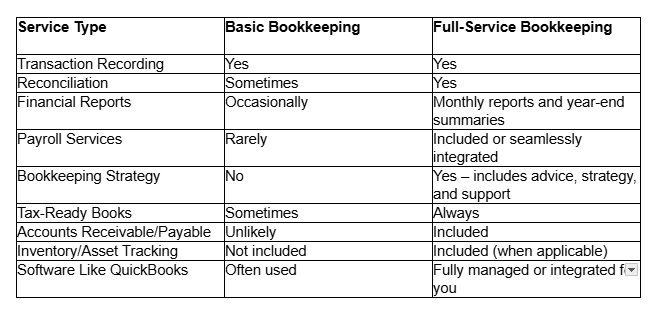
So, while basic bookkeeping is good for recording transactions, full-service bookkeeping covers the entire scope of your financial operations.
Who Needs Full-Service Bookkeeping?
If you’re running a small business or are a freelancer trying to stay organized, you may be wondering if you need full-service bookkeeping.
Here are some signs that it’s right for you:
You’re spending more time on accounting than growing your business
Your financial data is scattered or outdated
You're unsure how profitable you are month-to-month
You struggle with tax prep or compliance
You want to make data-driven financial decisions
You’re ready to scale and need real-time insight
Most importantly, full-service bookkeeping provides peace of mind. It gives business owners access to financial data they can trust.
Components of Full-Service Bookkeeping
Let’s explore the major components in more detail.
Transaction Management
Every invoice, expense, bill, and receipt should be recorded accurately. This includes reconciling credit card purchases, bank deposits, and inventory updates.
Payroll Integration
A full-service bookkeeper can also manage payroll - from calculating employee salaries and tax withholdings to ensuring labor law compliance and managing benefit deductions.
Financial Statement Preparation
The numbers don’t mean much if you can’t interpret them. That’s why full-service bookkeeping includes regular preparation of:
Balance Sheets – Snapshot of assets, liabilities, and equity
Cash Flow Statements – Understanding your cash in and out
Income Statements – Tracking revenue and expenses over time
These reports help you make informed business decisions.
Software Integration
A full-service provider will often work directly inside modern accounting software like QuickBooks. With integrated tools and cloud computing, your bookkeeping team will automate data entry, create real-time reports, and track financial performance from anywhere.
Customized Bookkeeping for Diverse Needs
Not every business fits into the same mold. A restaurant has different needs from a consulting business. That’s why customized bookkeeping is key.
Whether you need bookkeeping services to help with grant tracking, job costing, or complex financial reporting, your provider can tailor their support. Full-charge bookkeepers typically have experience across various industries and understand the nuances of each.
Customized services often include:
Tracking project-based income and expenses
Departmental accounting
Multi-entity reporting
Sales tax compliance
Cost of goods sold calculations
This approach to bookkeeping provides clarity and flexibility as your business evolves.
Why Outsource Bookkeeping?
Many business owners start with in-house bookkeeping or try to manage the books themselves.
But as businesses grow, so does the complexity of their financial processes.
Here’s where outsourcing bookkeeping tasks can save you time, money, and stress.
Benefits of Full-Service Bookkeeping
Increased Accuracy – Reduce errors and ensure financial records are accurate
Time Saving – Focus on running and growing your business
Access to Experts – Gain support from professional bookkeepers with certification and experience
Scalability – Add or remove services as your needs change
Compliance Confidence – Stay on top of payroll, tax, and regulatory changes
Improved Financial Reporting – Clear access to accurate financial statements and metrics
Efficient Audits and Tax Prep – All your documents are ready, accurate, and organized
Outsourced accounting services make it simpler to stay compliant and make smarter financial decisions throughout the year.
A Full Charge Bookkeeper vs. Basic Bookkeeper: What's the Difference?
A full-charge bookkeeper performs every step necessary to maintain a business's financial records, including supervising bookkeeping staff, reconciling accounts, and generating reports.
In contrast, a basic bookkeeper may be limited to data entry or bank statement matching.
A full-charge bookkeeping solution offers:
Full responsibility for the books from start to finish
A thorough understanding of financial recordkeeping, financial reporting, and account reconciliation
Expert support across balance sheets, income statements, and payroll
So if your business has grown beyond tracking receipts and invoices, hiring a full-charge bookkeeper may be the strategic move.
Importance of Full-Service Bookkeeping in Today’s Business Landscape
In today’s fast-moving world, businesses can’t afford gaps in their books. With tighter margins, changing laws, and increasing customer demands, full-service bookkeeping ensures you're on solid ground.
Here’s why it matters:
Improves cash flow through real-time reporting and alerts
Enables strategic financial planning with consistent data
Reduces risks related to tax compliance and audits
Offers clarity so you can make confident money decisions
Frees you up to focus on what you do best
Whether you're tracking multiple streams of income, monitoring assets and depreciation, or preparing for funding, the importance of full-service bookkeeping can’t be overstated.
Should You Invest in Full-Service Bookkeeping?
Investing in full-service bookkeeping isn’t just about keeping things neat. It’s about taking control of your business’s financial story.
If you’re looking for reliable bookkeeping in Denver, AY Miller offers personalized support tailored to your business’s unique needs. From detailed financial reports to outsourced accounting services, we help streamline your financial tasks so you can focus on what matters most.
To learn more about local, expert-run support, check out our Denver bookkeeping services.
Learn More or Take the Next Step
Still curious about how bookkeeping fits into your overall strategy? Want to better understand the difference between bookkeeping and accounting?
And remember, effective bookkeeping helps bring your business into focus - giving you the clarity to grow faster, plan smarter, and stay confident in your numbers.
Whether you're hiring a full-charge bookkeeper, outsourcing these services, or just looking for guidance, full-service bookkeeping can be the tool that unlocks your next phase of success.
